
A pigeon carried a message across a battlefield. Then a horseman carried a letter across a country. Then a telegraph operator tapped it down a wire. Then a telephone turned voice into electricity and ran it through copper strung between wooden poles on the side of the road.
Now you send a text. It bounces off a satellite, hits a cell tower, and arrives on a glass rectangle in your pocket. The message still gets there. The pigeon is gone. The infrastructure changed completely. The function didn't change at all.
We still call them "phones" — but they're computers that occasionally make calls. We still say "mail" — but it's an app, not an envelope. We still "rent movies" — but there's no store, no late fee, no VHS rewinder on the counter.
Books went from shelves to screens. Music went from vinyl to streams. Taxis went from medallions to apps. Hotels went from front desks to listings. The fax machine is in a landfill. The telephone pole is a relic. The bookstore is a memory. In every case, the function survived. The infrastructure got stripped away.
Rent is next.
Strip away the building. Strip away the tenant. Strip away the property manager and the insurance binder and the county tax assessor. What's actually generating the income?
Rent is a recurring payment from someone using an asset you control. That's it. A ground lease, a triple-net, a management contract — all variations on one idea: you own something, someone pays to access it, and a deposit shows up on a schedule.
A commercial building is just the container. The concrete and steel, the HVAC, the parking lot that needs resealing every three years — that's all infrastructure. The income doesn't come from the building. It comes from the agreement. The building is what makes the agreement enforceable — what gives the tenant a reason to pay and the landlord a right to collect.
So what if you had an asset that didn't need a building to enforce the agreement?
Bitcoin is the property. ₿762,099 and growing. Strategy is the developer — a company that acquires digital land and builds income-producing structures on top of it. (We explored this in our first article, Is Strategy a Marketplace?.)
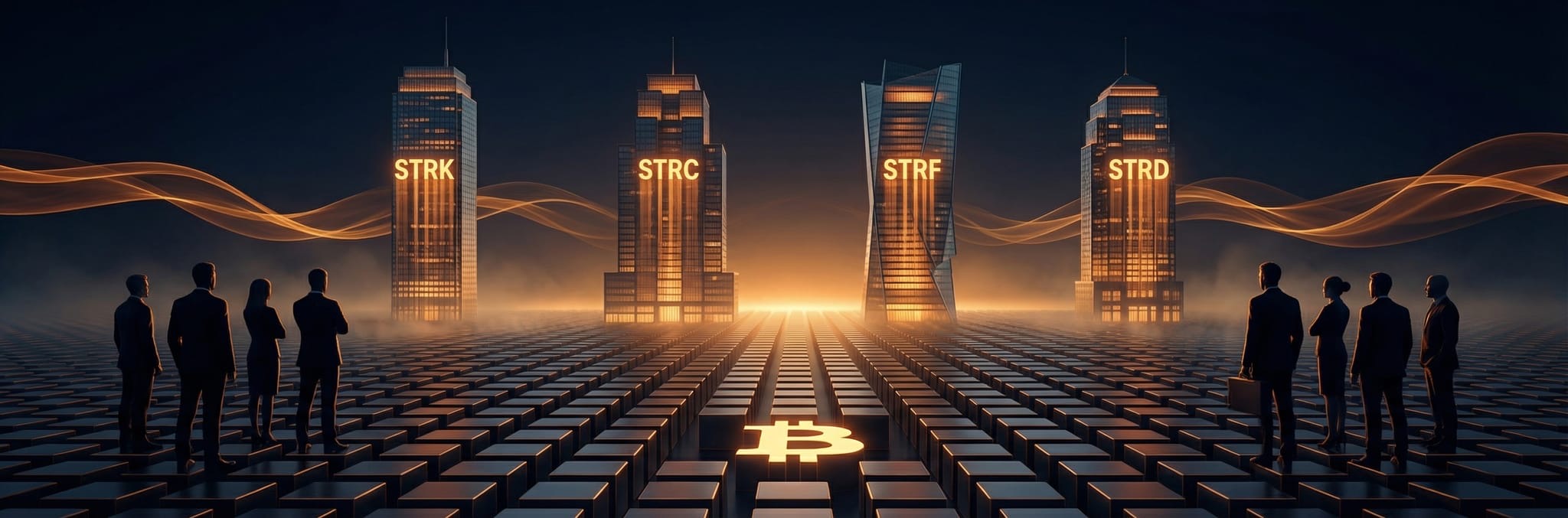
In commercial real estate, a developer buys raw land and constructs buildings that generate rent. Each building has its own lease structure, its own tenant profile, its own cash flow. Strategy does the same thing. It acquires bitcoin and issues preferred shares — each one a separate building on the same property, with its own yield, its own terms, and its own investor base.
The property doesn't need a zip code. But it has everything that matters: an underlying asset, a developer who keeps building, and a set of structures that generate predictable cash flow on a schedule that runs like clockwork.
The rent is digital. But the deposits are real.
Land is measured in square feet and priced per acre. Bitcoin is measured in satoshis and priced per coin. Both have a small unit and a lot unit. A square foot of raw land in the rural U.S. costs about ten cents. An acre — 43,560 square feet — runs roughly $4,356. A single satoshi costs a fraction of a penny. A full bitcoin — 100 million satoshis — trades at around …. Side by side:
Raw land doesn't generate income on its own. You have to improve it — pour a foundation, erect walls, install plumbing, get a certificate of occupancy, find a tenant, sign a lease. That process takes years and costs millions before the first rent check lands.
You build on bitcoin the same way you build on raw land — you improve it. When Strategy issues a preferred share against its bitcoin holdings, it turns unproductive digital land into an income-producing asset. Same logic, different material. But raw land takes years and millions in construction. Digital land takes one issuance and a ticker symbol.
Take $1 million. Put it into a commercial property. An 8% cap rate gets you $80,000 per year in gross rent. After insurance, property taxes, maintenance, and a management company taking their cut, maybe $50,000 nets to the owner. That's $4,167 per month.
Now take that same $1 million and deploy it into a 10% Strategy preferred. $100,000 per year in dividends. No insurance. No maintenance reserve. No management fee. No vacancy drag. $8,333 per month, deposited on a schedule, same as any rent check.
Same capital. Same cash flow structure. Different building materials.
A commercial developer doesn't build the same building four times. They study the market and construct different buildings for different tenants. An office tower for long-term corporate leases. A retail strip for month-to-month storefronts. A medical suite for specialized, high-credit tenants. Different structures, different risk profiles — all sitting on the same property.
Strategy's preferred shares are four buildings on the same digital property:
STRK — | — is the lease with a purchase option. An 8% perpetual preferred, convertible to common at a 10:1 ratio. You collect rent, You collect rent, but you also hold an option on owning the ground lease. If bitcoin rips and MSTR takes off, you can convert your preferred into common and ride the upside. The only pref in the stack with a path to equity — yield today, optionality tomorrow.
STRC — | — is the market-rate lease. A variable-rate perpetual preferred, non-convertible, with dividends paid monthly and the rate adjusted to keep shares trading near $100 par. In a hot market, the rate climbs. In a cold one, it resets. The rent is whatever the market will bear — like a month-to-month in a neighborhood where demand sets the price.
STRF — | — is the lease with a late-payment clause. A 10% perpetual preferred, non-convertible, with a penalty rider — if Strategy misses a dividend, the rate climbs 1 percentage point for each missed payment, up to a maximum of 18%. You get a flat 10% when everything runs smoothly. But if the landlord falls behind, the penalties stack. Capital that expects to get paid — and built-in consequences if it doesn't.
STRD — | — is the long-term fixed lease. A 10% perpetual preferred, non-convertible, with quarterly dividends. No conversion clause. No variable pricing. No escalation triggers. Just 10%, four times a year — like a tenant who signed a decade-long lease at a flat rate. Predictable cash flow for capital that values simplicity over optionality.
Four buildings. Four lease structures. One property.
Live data via strategy.com —
Here's what a commercial landlord deals with that a digital landlord doesn't:
A roof that costs $800,000 to replace. A HVAC that dies the hottest week of the year. A property tax assessment you'll spend $50,000 appealing to save $8,000. Insurance that doubles after a hailstorm. A management company that charges 8% to forward your maintenance requests.
Real estate investors call these operating expenses. They consume 30–40% of gross rental income before the owner sees a dollar. That $80,000 in gross rent? After the building takes its cut, it's $50,000.
Then April 15 arrives. Rental income is taxed as ordinary income — the same rate you pay on your salary. Depending on your bracket, the IRS takes another 24–37% of what the building didn't eat first.
Now look at the other side. In 2025, 100% of distributions on every Strategy preferred — STRK, STRC, STRF, STRD — were classified as return of capital. ROC isn't taxed as income when you receive it. It reduces your cost basis instead. You owe nothing until you sell, and when you do, the gain is taxed at long-term capital gains rates — 15 to 20%, not your ordinary rate. Hold until death, and your heirs receive a stepped-up basis. The deferred tax can disappear entirely. Strategy expects this treatment to continue for ten years or more.
The building eats 30–40% in expenses. The IRS taxes what's left as ordinary income. A preferred shareholder's $100,000 stays $100,000 — tax-deferred. The building works harder and gets taxed harder.
And then there's the tenant. Every commercial landlord knows the real risk isn't the roof — it's vacancy. An empty unit generates zero. The digital landlord's tenant is Strategy, a company sitting on ₿762,099 in bitcoin. No lease negotiation. No credit check. No sleepless night wondering if they'll make rent.
Here's where it gets interesting for anyone who already owns physical real estate.
A $3 million commercial property with a $1 million mortgage. The loan matures. You refinance — pull out an additional $1 million in equity at a 6% interest-only rate. New annual cost: $60,000.
Deploy that $1 million into a 10% Strategy preferred. New annual dividend income: $100,000.
Net new annual cash flow: $40,000. That's $3,333 per month you didn't have before the refinance. The physical building still generates its own rent. The digital property now generates a second income stream — stacked on top.
You haven't sold the property. You haven't added a tenant or a square foot. You've taken equity that was sitting dormant in a physical building and redeployed it into a digital property. The brick-and-mortar is the collateral. The bitcoin-backed preferred is the yield.
Two buildings. One balance sheet. Two rent checks per month.
Here's the uncomfortable question for every real estate investor: what's your hurdle rate?
A commercial property appreciating at 3–5% per year feels solid — until you measure it against bitcoin. Bitcoin has compounded at roughly 50% annually over the last decade. Even if that rate decelerates, a 5% real estate appreciation measured in bitcoin terms isn't growth. It's depreciation on a longer timeline.
Digital rents reframe the equation. Preferred dividends arrive in dollars — but dollars convert to bitcoin the same day they land. $8,333 per month in digital rents is $1,923 per week in bitcoin purchases. Over five years, at any meaningful appreciation rate, the sats accumulated from reinvested digital rents could be worth multiples of the dividends themselves.
The yield is denominated in dollars. The savings are denominated in bitcoin.
The dividend is the vehicle. Bitcoin is the destination.
A traditional landlord collects rent and parks it in a savings account that bleeds purchasing power every year. A digital landlord collects dividends and converts them to an asset with a fixed supply of 21 million. Same cash flow. Different vault. One leaks. The other locks.
Square feet and satoshis. Acres and bitcoin. Physical land and digital land. Both are measured in small units. Both produce income when structured correctly. One requires concrete, plumbing, insurance, a property manager, a good attorney, and a budget for everything that can go wrong. The other requires a brokerage account.
A landlord collects rent because they own a building. A preferred shareholder collects dividends because they own a claim on a bitcoin treasury company. The cash flow is the same. The schedule is the same. The deposit hits the same way.
The pigeon became a letter. The letter became an email. The email call became a text. The function never changed — the infrastructure did, every single time.
Rent was never about the building. It was about the agreement. The agreement just went digital.